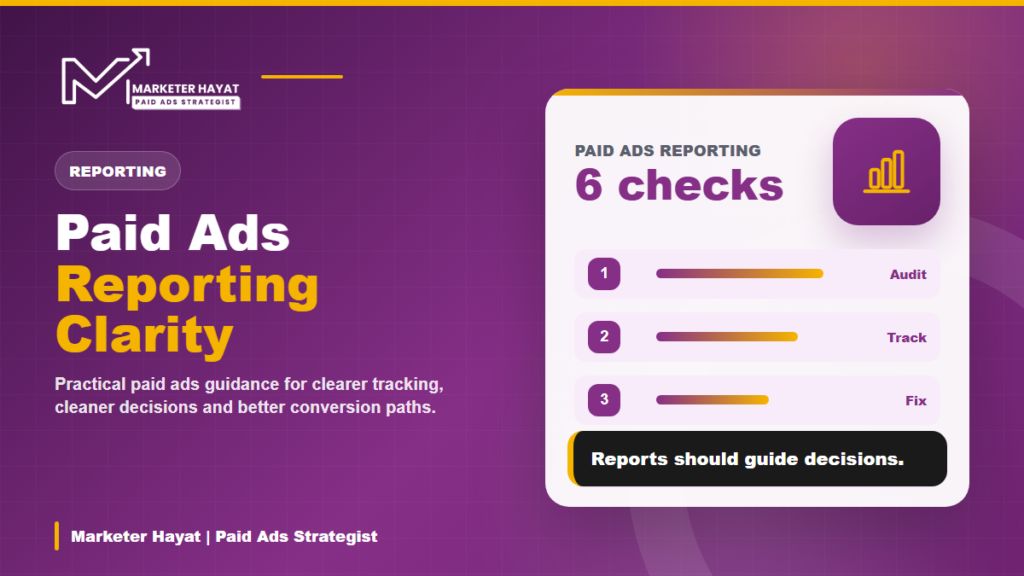
Quick answer: Paid ads reporting matters because business owners need to know what happened, why it happened and what should be tested next, not only see screenshots of clicks and spend.
Paid ads reports should help decisions. If a report only shows impressions, clicks, CTR and spend, the business may still not know whether the campaigns are producing useful leads, sales or customer conversations. Clear reporting connects platform metrics with real business outcomes.
Reporting should explain business impact
A good report does not simply repeat what the ad platform shows. It explains what changed, what improved, what became weaker and what should happen next.
For example, if leads increased but quality dropped, the report should not treat that as a simple win. It should review campaign source, landing page intent, form quality and follow-up outcomes.
Vanity metrics are not enough
Clicks, reach, impressions and engagement can be useful for diagnosis, but they are not the final goal for most businesses. A campaign can get strong engagement and still fail to create meaningful sales conversations.
Paid ads reporting should keep attention on qualified leads, calls, WhatsApp actions, sales, cost per real opportunity and what the business learned from the test.
Clear reports improve next-step decisions
The real value of reporting is the next decision. Should the campaign be scaled, paused, rebuilt, retested or supported with a better landing page? A clear report helps answer that question.
Reporting should also connect with case studies and account history over time. This makes it easier to see whether improvements are coming from better traffic, better tracking, better landing pages or stronger follow-up.
Why honest reporting beats guaranteed-result claims
No honest paid ads strategist should guarantee results. Performance depends on the market, offer, budget, tracking, creative, landing pages and follow-up process.
Honest reporting shows what is known, what is uncertain and what should be tested next. That kind of clarity helps businesses make calmer decisions instead of reacting to every short-term movement.
Practical next step before changing campaigns
Before making major changes around paid ads reporting, write down what the account is currently trying to achieve, what is being measured and which business result matters most. This keeps the review focused on useful decisions instead of random campaign activity.
The next step should be small enough to measure clearly. For one account, that may mean fixing conversion tracking. For another, it may mean improving the landing page, simplifying the campaign structure or reviewing lead quality before increasing spend.
A stronger paid ads system usually comes from connected improvements, not one isolated setting. Campaigns, creative, tracking, reporting, landing pages and follow-up all need to support the same business goal. That is why the best next action is the one that removes the biggest point of confusion first.
- Confirm the main conversion action.
- Check whether the landing page supports the ad promise.
- Review lead quality, not only lead volume.
- Make one clear improvement before testing the next idea.
FAQs
What should a paid ads report include?
It should include spend, conversions, lead quality signals, campaign performance, tracking notes, landing page observations and clear next-step recommendations.
Are screenshots enough for reporting?
No. Screenshots can support a report, but the report should explain meaning, context and next actions.
Does Marketer Hayat provide direct reporting?
Yes. The work is built around direct communication, honest reporting and practical recommendations.
Need a clearer view of your ad account?
If paid ads reporting is becoming hard to measure, request a direct paid ads audit from Marketer Hayat. The review focuses on campaign structure, conversion tracking, landing page flow and practical next steps.
Written for businesses that want clearer paid ads decisions, cleaner tracking and practical reporting from Faisal Saleh Hayat and Marketer Hayat.