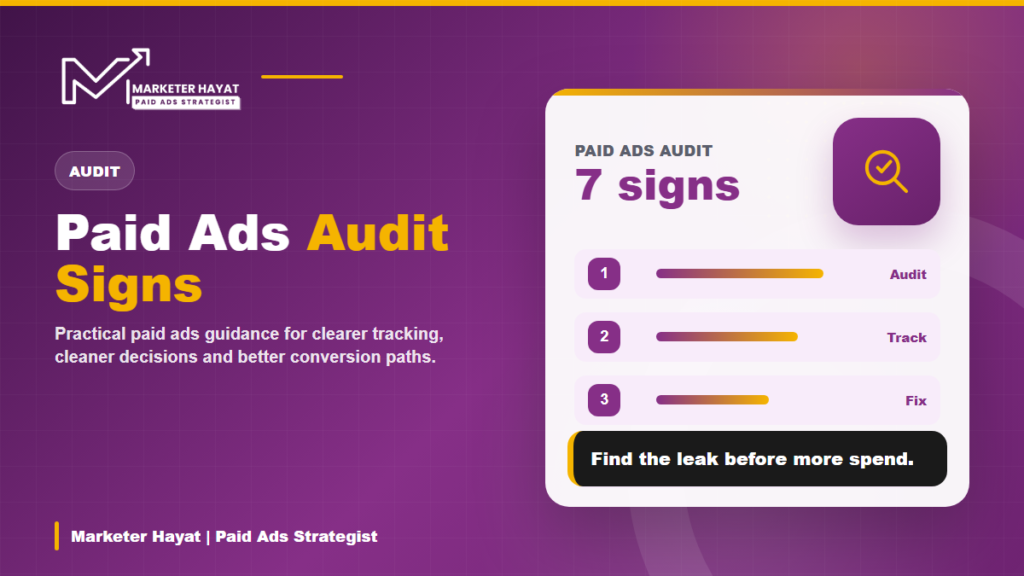
Quick answer: Your ad account needs a paid ads audit when results are hard to explain, tracking is unclear, lead quality is weak or changes are being made without a clear strategy.
A paid ads audit is not only for accounts that are failing. It is useful when the business needs clarity. Many accounts spend money every day without a clean explanation of what is working, what is wasting budget and what should be tested next.
Results are hard to understand
If reports show clicks, impressions and leads but the business still does not know what is producing revenue, the account needs a closer review. Reporting should explain performance, not just display numbers.
A useful audit looks at the connection between spend, campaign structure, conversion tracking and the quality of the leads or sales being generated.
Tracking does not match real business outcomes
One of the clearest signs is mismatch. The ad platform may report conversions, but the business may not see the same lead quality, call volume, WhatsApp activity or revenue.
This does not always mean the platform is wrong. It may mean events are firing incorrectly, duplicate conversions are counted, low-intent actions are treated as leads or offline follow-up is not connected to the reporting.
Lead quality is weak
Cheap leads are not always good leads. If people are submitting forms but not responding, not matching the service area or not understanding the offer, the problem may be targeting, ad copy, landing page framing or the offer itself.
An audit should review the full path from ad message to landing page to follow-up. Weak lead quality is rarely solved by one button or one campaign setting.
Campaigns keep changing without a plan
Constant changes can make performance harder to read. If budgets, audiences, keywords and creatives are changed every few days without a clear testing structure, the account may never collect clean learning.
A paid ads audit from Faisal Saleh Hayat focuses on practical next steps: what to stop, what to fix, what to test and what to measure before increasing spend.
- Campaign structure
- Conversion tracking
- Landing page flow
- Offer clarity
- Lead quality and follow-up
- Reporting and next-step recommendations
Practical next step before changing campaigns
Before making major changes around paid ads audit, write down what the account is currently trying to achieve, what is being measured and which business result matters most. This keeps the review focused on useful decisions instead of random campaign activity.
The next step should be small enough to measure clearly. For one account, that may mean fixing conversion tracking. For another, it may mean improving the landing page, simplifying the campaign structure or reviewing lead quality before increasing spend.
A stronger paid ads system usually comes from connected improvements, not one isolated setting. Campaigns, creative, tracking, reporting, landing pages and follow-up all need to support the same business goal. That is why the best next action is the one that removes the biggest point of confusion first.
- Confirm the main conversion action.
- Check whether the landing page supports the ad promise.
- Review lead quality, not only lead volume.
- Make one clear improvement before testing the next idea.
FAQs
How often should an ad account be audited?
There is no fixed rule, but an audit is useful before scaling, after performance drops or when reports no longer explain real business results.
Is a paid ads audit only for Meta Ads?
No. A paid ads audit can review Meta Ads, Google Ads, landing pages, tracking, reporting and the wider conversion path.
Can I request a free audit from Marketer Hayat?
Yes. Use WhatsApp or the contact page to request a direct review.
Need a clearer view of your ad account?
If paid ads audit findings is becoming hard to measure, request a direct paid ads audit from Marketer Hayat. The review focuses on campaign structure, conversion tracking, landing page flow and practical next steps.
Written for businesses that want clearer paid ads decisions, cleaner tracking and practical reporting from Faisal Saleh Hayat and Marketer Hayat.